
On March 14, the Special Course for Young People started for the sixth time ahead of the Russian Internet Governance Forum (RIGF 2026).
Together with invited experts, participants will discuss key topics from the RIGF 2026 program and develop a set of theses reflecting young people’s perspectives on current internet governance issues. The results of their work will be presented at the closing session of the forum.
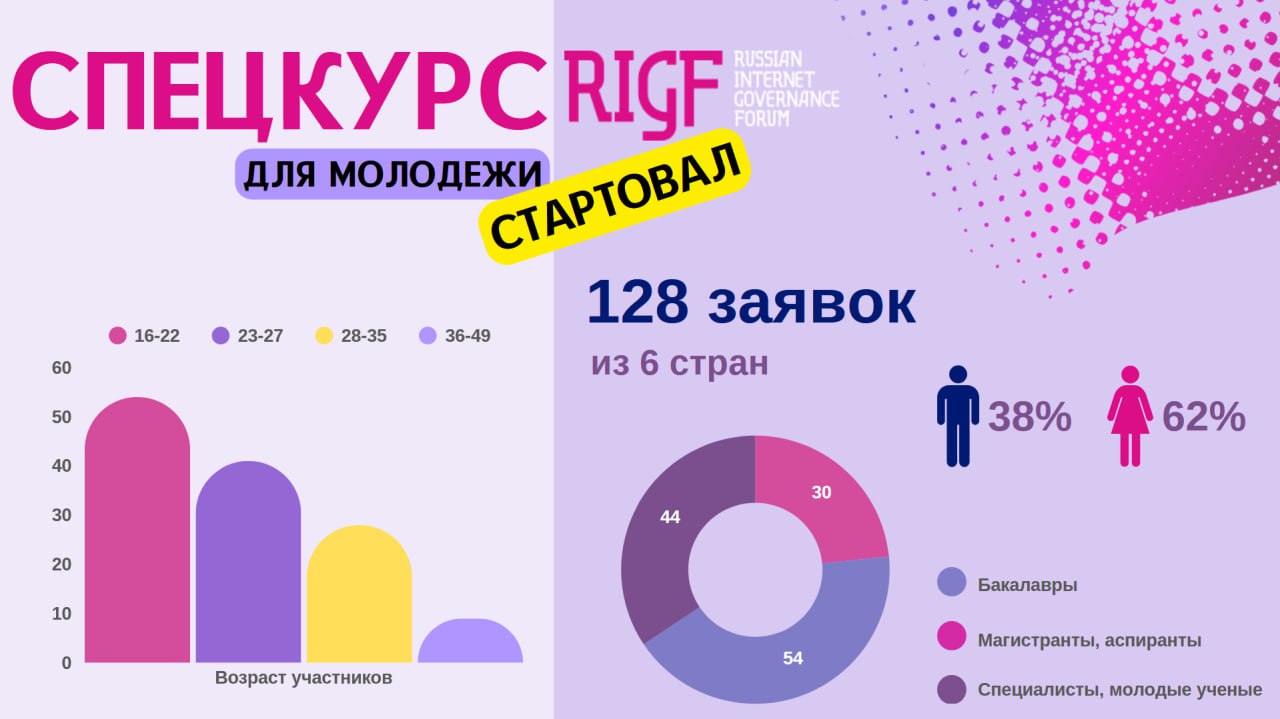
This year, the Special Course received 128 applications from six countries. Most applications came from Russia, as well as from Belarus, Kazakhstan, Kyrgyzstan, Turkmenistan, and Serbia.
The majority of applicants are under 22 years old, while the second-largest age group is 23-27. In terms of education and professional status, the largest groups are bachelor’s students (54 applications), master’s students (29 applications), and young professionals and researchers (45 applications). As in previous years, women make up the majority of applicants, accounting for more than 60 percent.
As before, the participants represent a wide range of professional backgrounds. The largest number of applications came from IT specialists working in development, administration, and information security, as well as from experts in international relations and political science, lawyers, and economists.
When opening the Special Course, Director of the Coordination Center for TLD .RU/.РФ Andrey Vorobyev presented participation statistics and outlined the main selection criteria. He noted that many participants return to the course more than once: this growing interest highlights the initiative’s relevance. The Coordination Center is consistently developing projects aimed at involving young people in internet governance processes and building a sustainable professional community around them. The participants’ strong engagement and enthusiasm confirm the importance and practical value of such educational programs.
Maria Bolshakova, Deputy Director General of the Regional Commonwealth in the Field of Communications, delivered the first lecture of the course titled WSIS+20: Global Digital Dialogue – From Words to Action. The lecture explored the outcomes and future prospects of global digital cooperation twenty years after the World Summit on the Information Society (WSIS). The presentation reviewed key achievements in developing mechanisms for international cooperation and highlighted current challenges, including digital inequality, cybersecurity, data protection, and the regulation of artificial intelligence. Special attention was given to the shift from declarative principles of global digital dialogue toward the implementation of concrete, practical initiatives.
The second lecture, The Legal Landscape in Generative AI, was delivered by Karen Kazaryan, Director of Analytics at the Digital Economy Autonomous Nonprofit Organization and CEO of the Internet Research Institute. The lecture examined current approaches to regulating generative artificial intelligence technologies, which are rapidly moving beyond the experimental stage and becoming an integral part of everyday life and a key driver of technological development. The expert also reviewed international regulatory practices, outlined the main risks associated with generative AI, and discussed possible future directions for legal regulation in this field.
The next lectures of the Special Course will take place on March 21, when experts will address topics including digital media advertising and online child safety.


