
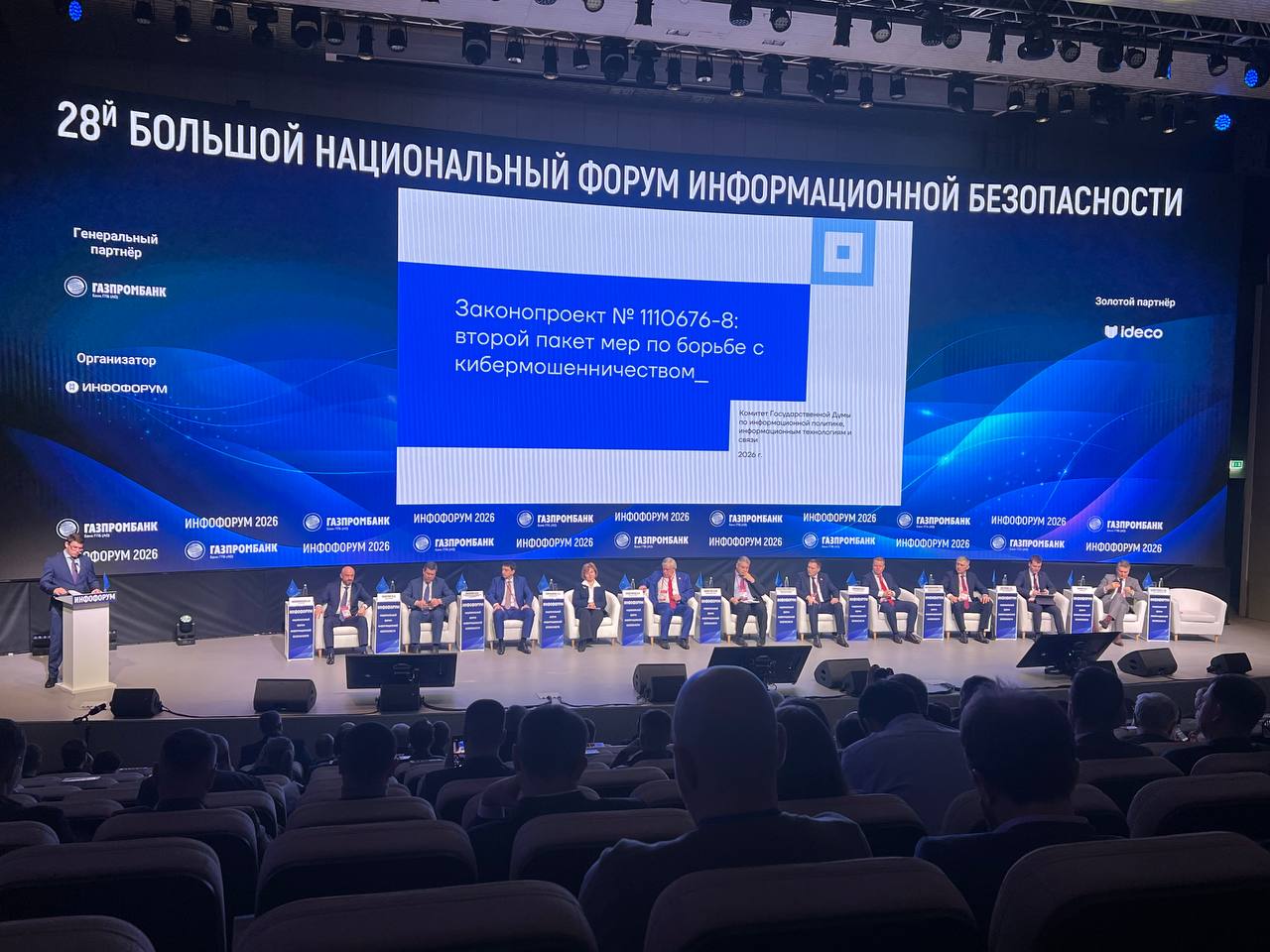
The 28th National Information Security Forum, or Infoforum 2026, is taking place in Moscow on January 28–29. The forum focuses on cybersecurity strategies for critical information infrastructure, including building trust in digital tools. More than 3,000 specialists from 65 Russian regions are participating in the event both offline and online, representing federal and regional government bodies, local authorities, academia, education, and businesses.
The forum opened with a plenary session, Priorities of Russia’s Information Security: Staying One Step Ahead. In his opening remarks, Alexander Shoytov, Russian Deputy Minister of Digital Development, Communications, and Mass Media, emphasized that the forum’s central theme was ensuring Russia’s information security and countering cyberthreats across key sectors of the economy. Particular attention is being paid to the security of critical infrastructure, digital sovereignty and import substitution, breakthrough technological solutions, new security strategies, legislative development, and international cooperation.
“Achieving technological leadership and import independence requires a proactive and centralized approach to security, especially in the context of constant technological competition. It is necessary to ensure cybersecurity across key technological areas by 2030. Priority tasks include countering cyberattacks, developing antivirus technologies, protecting satellite and drone systems, and securing digital ecosystems, including 5G and 6G communication networks, big data, and artificial intelligence,” Alexander Shoytov noted.
Sergei Boyarsky, State Duma Deputy and Chair of the State Duma Committee on Information Policy, Information Technology and Communications, presented a report, On the Practice of Enforcement of Anti-Fraud Measures and the Second Anti-Fraud Legislative Package.” He stated that combating cyberfraud was a key focus of the committee’s work in 2025. Prior to the adoption of the first anti-fraud package, cybercrime was growing at an annual rate of around 30 percent. However, by the fall of 2025, following the law’s entry into force on September 1, a 25 percent decline was recorded. The key measures included the self-imposed bans on loans, already used by 21 million people, and limits on owning SIM cards, with 20 allowed for Russian citizens and 10 for foreign nationals.
Alexei Ivanov, Deputy Director of the National Computer Incident Response and Coordination Center, reported that in 2025, distributed denial-of-service (DDoS) attacks and malware injections continued to dominate the structure of computer incidents. He noted that DDoS attacks were often directed at telecom operators rather than at the end target itself.
The Coordination Center for TLD .RU/.РФ participated as a partner in a session, International Cybersecurity Issues: Key Problems and Solutions. The session was co-moderated by Andrey Vorobyev, Director of the Coordination Center; Boris Miroshnikov, President of the National Association for International Information Security and Co-Chair of the Infoforum Organizing Committee; and Dmitry Bukin, Deputy Director of the Department of International Information Security at the Russian Foreign Ministry.
Olga Baskakova, Project Manager at the Coordination Center, addressed threats in the Russian domain space. She presented key trends in the evolution of cyber threats, summarized the results of the Domain Patrol project in 2025, and outlined forecasts for the current year. She also highlighted the continued growth of targeted attacks on DNS infrastructure, the increasing sophistication of AI-driven phishing campaigns, the rise in long-term “silent” attacks, and the emergence of new types of attacks targeting DNSSEC.
“Attacks are getting larger and more complex. Ensuring the security of the domain space requires a comprehensive approach that combines modern technologies, primarily artificial intelligence, with well-established processes and close cooperation among market participants,” she emphasized.
In 2025, more than 62,000 requests were processed by Domain Patrol, resulting in the termination of domain delegations in 98 percent of cases.
“There has been an increase in situations where administrators promptly eliminate violations. Competent organizations, including the National Computer Incident Response and Coordination Center, are actively involved in analyzing such cases and assisting administrators. This proves that the project remains relevant and effective,” Olga Baskakova noted.
She also pointed out that in 2025, the effectiveness of blocking malicious resources through official mechanisms involving the Prosecutor General’s Office and Roskomnadzor increased significantly.
“Blocking at the level of technical means for countering threats (TSPU) is particularly important when dealing with foreign domains. In 2026, a key step for the domain industry will be taken – the introduction of administrator verification through the Unified System of Identification and Authentication (USIA),” Olga Baskakova concluded.


