

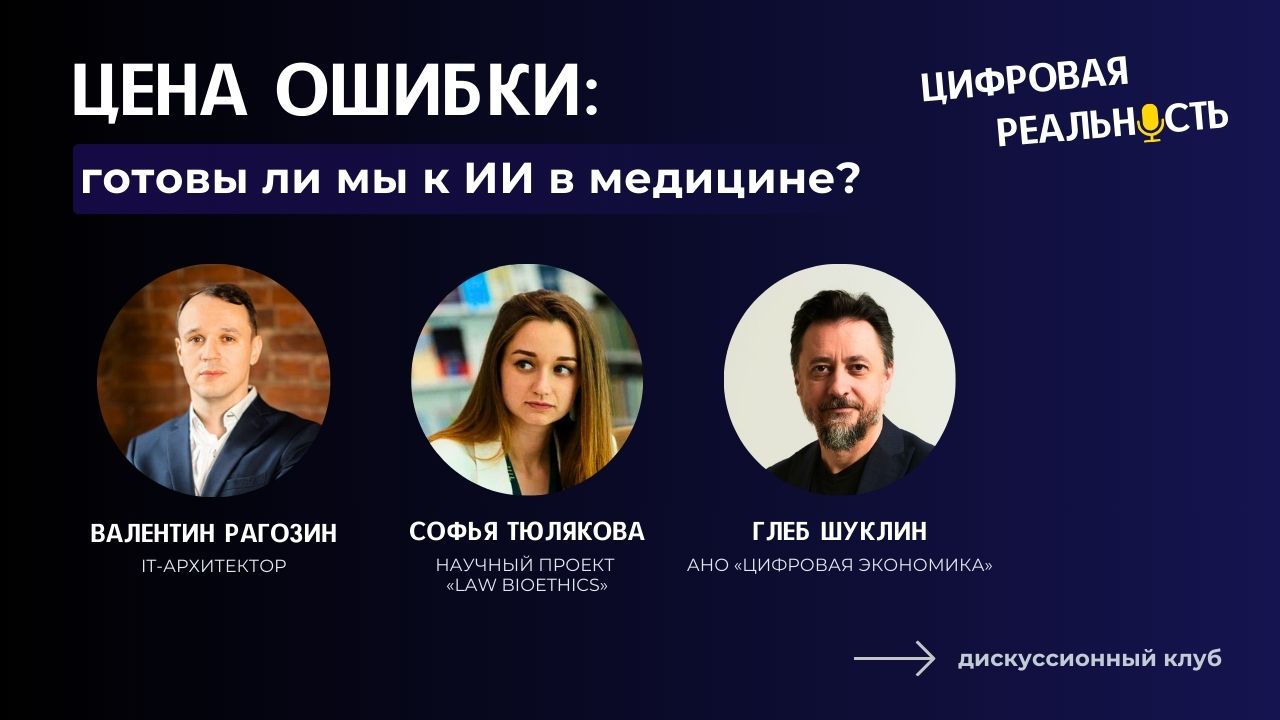
On December 18, experts of the Digital Reality discussion club debated on air the use of AI in medicine and its role in diagnosing, data processing and decision-making support.
Guests of the broadcast:
- Valentin Ragozin, IT-architect
- Sofya Tyulyakova, author of the Law Bioethics science project
- Gleb Shuklin, Director, expert, medical data turnover group, Digital Economy Autonomous Non-Profit Organization
Club moderator – Mikhail Anisimov, ICANN representative for contacts with interested parties in Eastern Europe and Central Asia.
The experts discussed what medical AI should be trained on if data is dispersed, fragmented, and restricted by personal data regulations. Valentin Ragozin noted that AI can be useful in processing documentation and supporting diagnostics, but therapeutic decisions should rest with the doctor.
Sofya Tyulyakova agreed with his opinion: “Artificial intelligence is a tool; it does not replace doctors, just as the Internet has not replaced lawyers.”
Gleb Shuklin compared the use of AI in medicine to autonomous transport: “Liability for the decisions always remains with the human being, the algorithm cannot be punished.”
Participants paid special attention to digitizing medicine and data reliability. Mikhail Anisimov drew attention to the Genesis project, which is intended to digitize scientific information for training AI that is capable of making discoveries. Gleb Shuklin added that problems of access to data, its structuring and anonymization remain the main barriers, and Valentim Ragozin warned about security risks in creating a single data base as it may become a target for cyberattacks.
In expert estimates most promising areas for AI application include the analysis of medical images, processing of protocols and genetic data as well as providing a second opinion to doctors.
“The AI must be able to ‘read between the lines’ in medical documents and legislation,” Sofya Tyulyakova emphasized the importance of understanding the context.
Despite the lack of breakthroughs, the participants pointed out the gradual development of technologies and the AI potential for relieving doctors of routine work, raising the quality of diagnostics, and more accurate interpretation of medical data.


